
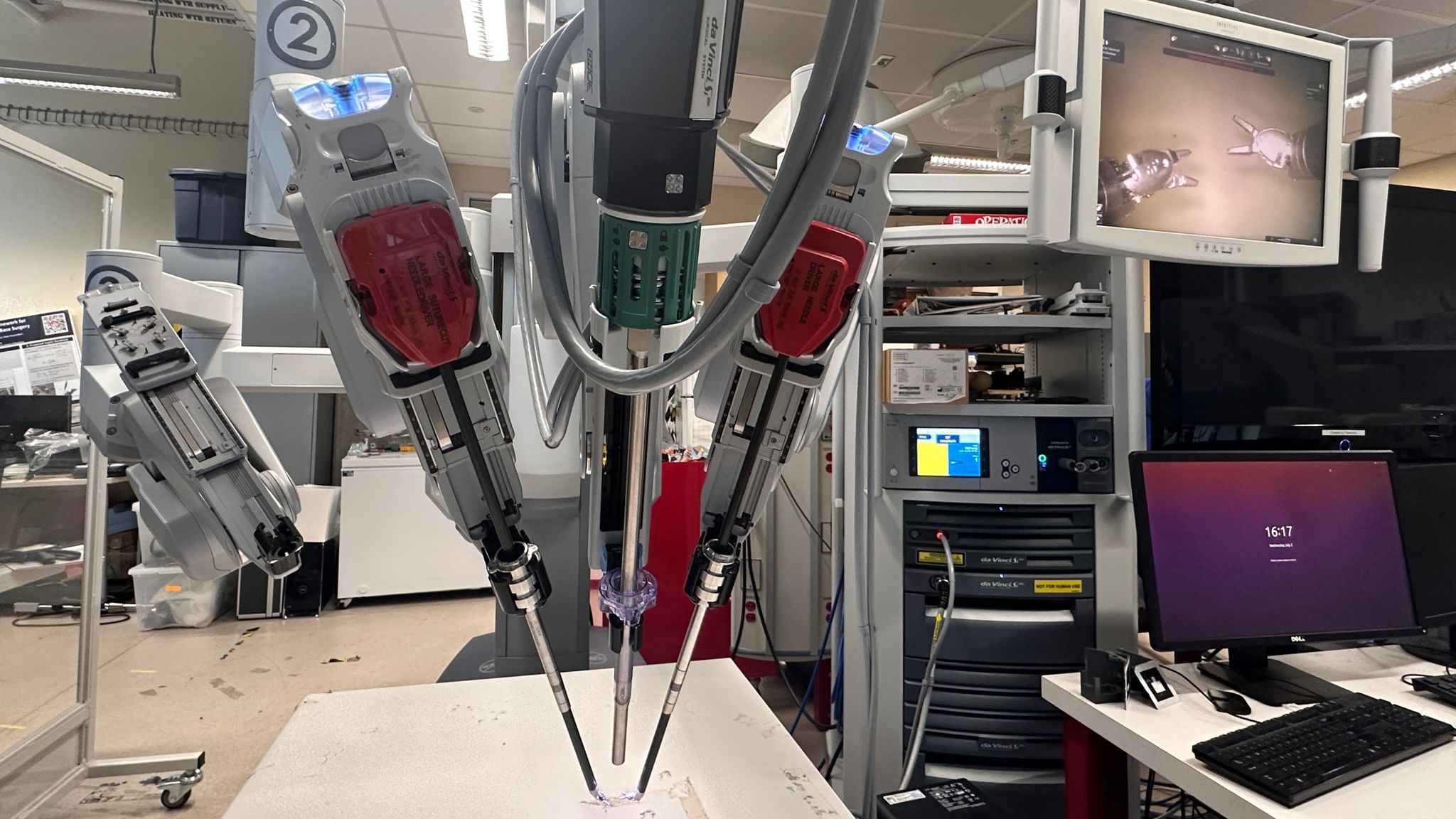
The framework treats healthcare robotics as physical AI systems, shifting the focus from text-based learning to contact, force, and consequence. By combining classical physics modeling—which handles the mechanical rules of catheters and tissue resistance—with generative AI that simulates visual scene dynamics, Nvidia allows developers to generate edge cases on demand. Instead of waiting for a rare surgical complication to occur in an operating theatre, teams can now simulate a guidewire catching on a vessel wall or a kidney stone lodged at an unusual angle.
Scaling clinical simulation
Running these simulations on GPUs using Nvidia’s Warp and Newton libraries enables massive parallelization. In benchmarks, the company reported that executing 8,192 parallel environments reduced training time from over five hours to under two minutes. Early adopters are already experimenting with this scale: CMR Surgical has contributed 500 hours of anonymized clinical data to the Open-H Embodiment dataset, while Johnson & Johnson MedTech is building a digital twin of its MONARCH platform to refine urological procedures. XCath and Inner Logic are similarly using the synthetic data to train endovascular autonomy and validate device mechanics.



Comments (0)
No comments yet. Be the first!